


Driving Outcomes in High-Stakes AI: Takeaways from AI 150
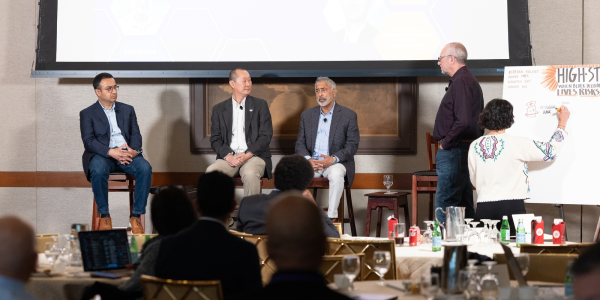
Overview: Welldoc's Chief AI Officer, Anand Iyer, shares takeaways from Constellation Research's AI 150 summit on high-stakes AI in healthcare. Key points include prioritizing direction over speed, using deterministic logic for high-risk clinical decisions, and small language models that cut token costs by 80% to 90%.
At Constellation Research’s prestigious Artificial Intelligence 150 summit, industry leaders gathered to address one of the most critical topics in modern technology: High-Stakes AI: When Better Decisions Impact Lives, Risk and Outcomes.
As one of the 2024 honorees on Constellation’s AI 150 list, Welldoc’s Chief AI Officer, Anand Iyer, PhD, MBA, was invited back to attend and speak on a panel at the 2026 summit alongside fellow executives, innovators, and thought leaders. The conversation made one thing clear: scaling AI isn't just about raw speed—it’s about clarity, direction, and driving measurable, high-value health outcomes while managing risk.
Here are the primary takeaways our Chief AI Officer, Anand Iyer, brought back from the summit:
1. Direction Over Speed
While 40% of enterprises report scaling AI agents, only 5% have the necessary data infrastructure and governance in place. As Constellation Research’s CEO, Ray Wang, highlighted, success requires velocity—which means speed with direction. Knowing what not to build is just as essential as knowing what to build. At Welldoc, robust data governance and alignment across leadership remain foundational to every model we deploy.
2. Matching the Tool to the Risk: Deterministic vs. Probabilistic
In high-stakes environments like healthcare, precision is paramount. Panelists emphasized that if a process demands 100% precision, deterministic, rules-based logic often outperforms complex probabilistic models. High-risk, clinical-grade decisions require absolute reliability, whereas probabilistic models excel in complementary roles. Bifurcating low-risk and high-risk applications ensures maximum clinical impact without compromising safety.
3. The Power of Small Language Models (SLMs)
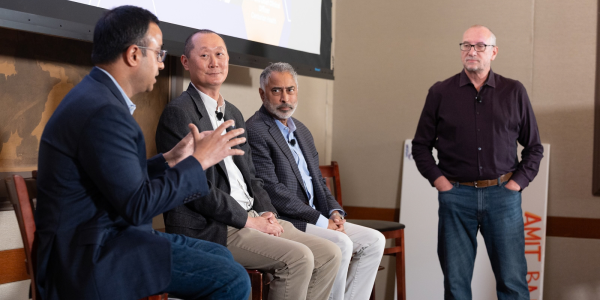
Frontier models offer immense capabilities, but specialized tasks don't always require massive architectures. Small Language Models (SLMs) can reduce token costs by 80% to 90% while delivering targeted efficiency. An AI assistant handling administrative tasks or data workflow reconciliation doesn't need to be trained on general world knowledge—it needs to be fast, accurate, and purpose-built.
4. Measuring What Matters
Rather than tracking the sheer volume of AI use cases, organizations must measure problem-points solved and concrete value delivered. Transformational returns aren't incremental—they should be measured on exponential scales, streamlining processes that once took years down to weeks.
At Welldoc, our mission continues to focus on leveraging intelligent, safe, and actionable AI to support individuals and clinicians in managing complex and cardiometabolic conditions. By pairing smart governance with purposeful technology, we ensure our high-stakes AI delivers the right support at the right time.
Learn more about the Welldoc Platform and our AI & Innovation.
Featuring
Additional Resources
View All Resources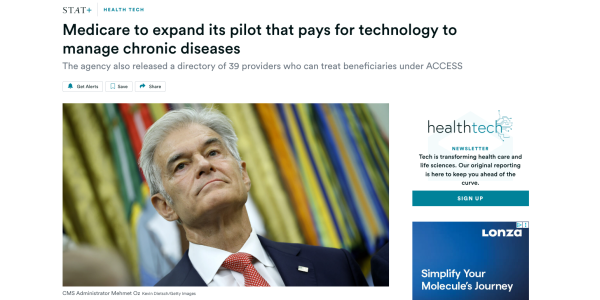
Welldoc Featured in STAT News as CMS Expands Value-Based ACCESS Model
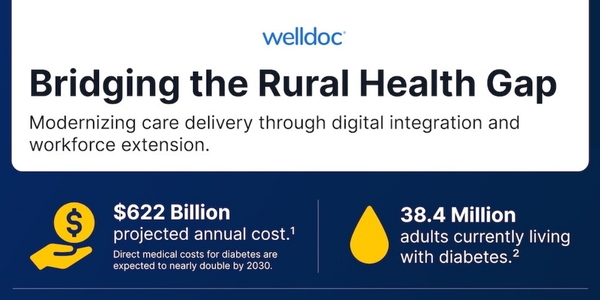
The Rural Health Gap: Why We Need More Than Just a “Transformation Fund”

Setting the Standard: Welldoc Earns DiMe Seal for Forthcoming CMS Medicare App Library
Discover the future of chronic care management
.webp)
.avif)