


The Rural Health Gap: Why We Need More Than Just a “Transformation Fund”

In March, NPR, KFF Health News, and Montana Public Radio reported on a growing tension inside the $50 billion Rural Health Transformation Program (RHTP). Congress created the five-year fund in the 2025 budget reconciliation law (H.R. 1) to help rural communities adjust to upcoming Medicaid changes. But the program is built to fund new ways of delivering care, not to cover deferred maintenance or prop up existing service lines.
Seven months later, that design is playing out. States have their first-year awards and are now funding projects. Tennessee announced 53 projects in September. Alabama awarded 34 grants totaling nearly $55 million in its second round. West Virginia is funding care management and AI tools for community health centers. The question is no longer whether the fund is big enough. It's whether states spend it on models that keep care close to home.
For Montana, the stakes are concrete. The state received $233.5 million for 2026, the fourth-largest award in the country, and could see close to $1.2 billion over five years. Its plan pairs stabilizing rural hospitals with restructuring recommendations, including "right-sizing" some inpatient services. Some rural hospital leaders worry that could mean fewer services close to home, and Montana is one of at least 10 states where that question has come up.
Meanwhile, the need keeps growing. Since the 1990s, diabetes rates in Montana have tripled, particularly among American Indian and Alaska Native adults. Nationally, 197 rural hospitals have closed or stopped inpatient care since 2005, and many others have shuttered vital services like obstetrics.
When services shrink, patients don't move. So how do we keep care continuous for people whose hospital has changed, even if their address hasn't?
Beyond the Four Walls: A Blueprint for Transformation
Rural health transformation isn't just about the financial survival of buildings; it's about the financial sustainability of care delivery. Montana's own plan points the same way: it funds expanded telehealth and electronic health record upgrades, and the state will measure its progress partly on glycemic status, hypertension, and obesity. Our work in Montana shows how the pillars of the RHTP can be implemented today.
- Workforce Extension: When a rural hospital cuts services or closes, providers often leave the area. In Montana, digital health allowed 11 Diabetes Care and Education Specialists (DCES) to maintain a continuous connection with 198 patients, regardless of their proximity to a physical clinic.
- Consumer-Facing Technology: Access remains the primary barrier in "frontier" communities. Digital tools fill the gap between episodic doctor visits, which often require long commutes, by providing on-demand support for the daily self-care behaviors that actually drive outcomes.
- Outcomes & Program Measurement: States began RHTP progress reporting in August 2026, so every funded program will need to prove it works. In Montana, two-thirds of users who tracked their glucose improved their control. Among the most engaged users, the average improvement in estimated average glucose (eAG) was -47 mg/dL¹. Those who achieved weight loss saw an average reduction of 7%¹ from their baseline.
- Inclusive Engagement: Digital health is often criticized as being only for the tech-savvy, but the Montana study showed that 30% of participants were aged 65 or older. When the need for care is high, the "digital divide" can be bridged with the right tools.
The Strategic Path Forward
If we only debate the size of the fund, or which service lines to cut, we miss the opportunity to modernize the model. Digital health platforms let systems expand capacity by automating routine monitoring and freeing clinicians to focus on the most complex cases. That matters most where a hospital is shifting care to outpatient or regional settings: the chronic care relationship doesn't have to move with it.
The National Rural Health Association has cautioned that cutting money-losing services can backfire, pushing more families out of small towns and shrinking hospital volumes further. Digital care offers a way to add capacity instead of subtracting it.
The goal of a true transformation fund should be to move rural health from a state of crisis to a state of resilience. Montana has shown that when we integrate technology into the existing care team, we don't just bridge a gap, we build a more sustainable future for the nearly 1 in 5 Americans living in rural communities.
Is your organization preparing for your state's next RHTP funding round?
Book a partnership briefing or download the Montana Case Study for real-world results.
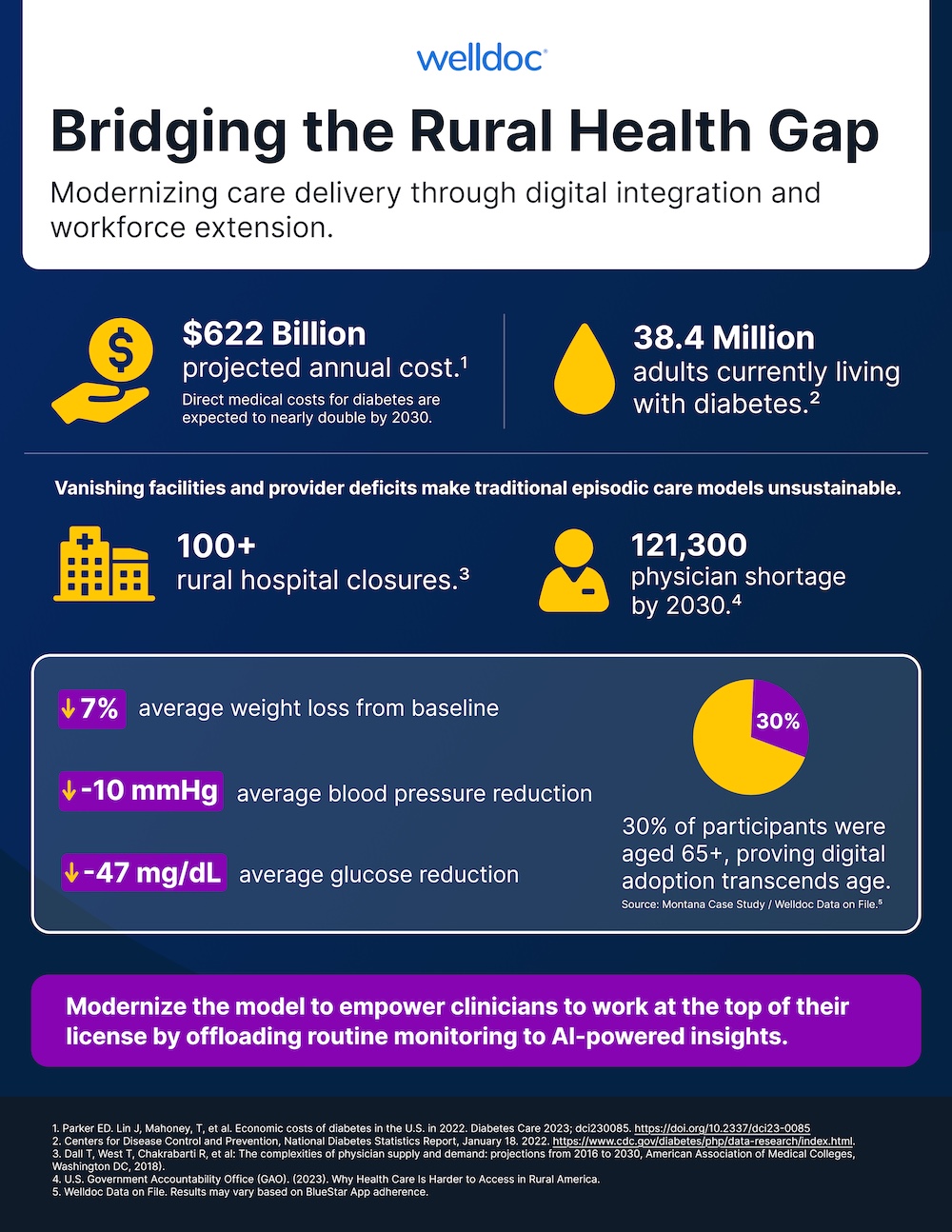
1. Welldoc Data on File. Results may vary based on App adherence.
Featuring
Additional Resources
View All Resources
Driving Outcomes in High-Stakes AI: Takeaways from AI 150
Welldoc Featured in STAT News as CMS Expands Value-Based ACCESS Model

Setting the Standard: Welldoc Earns DiMe Seal for Forthcoming CMS Medicare App Library
Discover the future of chronic care management
.webp)
.avif)