


The Pathway from Research to Reality: Realizing the Promise of Responsible AI in Healthcare

The prevalence of artificial intelligence (AI) in healthcare has skyrocketed in recent years – enabling the advancement of solutions powering more personalized, preventative care. With these new offerings comes the need for responsible and judicious research to ensure that the AI-driven solutions that reach users have undergone rigorous clinical testing.
Alarmingly, most research on AI in healthcare has not been conducted in a clinical setting1 – leading to a lack of practical data and the inability to predict how these AI-powered solutions will perform once integrated into individuals’ care plans.

Welldoc is progressing an ongoing clinical research strategy designed to pave the way for responsible AI in healthcare, and just recently presented groundbreaking AI-focused research at multiple industry conferences, including FNCE, DTM and INFORMS. This latest collection of AI research expands Welldoc’s portfolio of 37 AI-focused publications – solidifying its leadership in developing clinically rigorous health tech capabilities.
A generative AI model for glucose predictions
Innovations in real-time sensor technology, like continuous glucose monitors (CGM), provide valuable individual health data to inform complex condition support. Pairing this raw data with an AI-powered digital health solution unlocks the ability to identify trends and predict outcomes. Access to accurate glucose value predictions and the subsequent, automated coaching based on these insights have been shown to support the self-management of diabetes.2 To better understand the potential of AI-powered glucose predictions, Welldoc conducted four studies evaluating the application of its novel generative AI model designed to improve health outcomes through predictive analytics. This research was recently presented at the MLHC, EASD, FNCE, DTM and INFORMS annual meetings.
Welldoc constructed and tested the accuracy of a transformer-based Large Sensor Model (LSM) to predict glucose trajectories over 30-minute, 60-minute and 2-hour intervals. These predictions, which Welldoc refers to as continuous glucose monitoring (CGM)-GPT, were tested for accuracy using a diverse set of real-world CGM data collected from Welldoc’s comprehensive digital health platform for cardiometabolic condition management.
Model accuracy was evaluated in individuals with Type 1 (T1D) and Type 2 (T2D) diabetes, across different glucose levels, times of day, age groups and genders. Welldoc also tested the accuracy of the model when presented with novel glucose values it had not been exposed to during the training phase of model development.
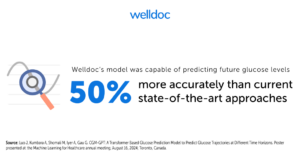
Data show that the model was capable of predicting future glucose levels 50% more accurately than current state-of-the-art approaches. With the integration of this new model, Welldoc’s digital health platform has the potential to deliver more predictive analytics, insights, interventions and improved outcomes to individuals living with T1D and T2D.
Harnessing the predictive power of AI for weight loss
The predictive potential of AI is not limited to glucose levels. In another recent study conducted by Welldoc and presented at FNCE, data show the potential of a machine learning (ML) model to aid in weight loss predictions powered by macro- and micro-nutrient data.
Model prediction accuracy was evaluated in individuals with T2D. Food, carbohydrate, meal planning and recipe entries were used as input sources to derive different macro- and micro-nutrient data associated with each meal.
The nutrient data from the four food-related categories were used to train an XGBoost ML model to predict weight loss, with Shapley analysis used to evaluate the effect of different macro and micro-nutrients on the accuracy of the weight loss predictions.

Data show the ML model was able to predict at least 3% weight loss with 93% accuracy, as well as the effect of variables like nutrients and time-based correlations. These results demonstrate the exciting potential of AI-modeling to support weight loss-related outcomes across comorbid conditions like diabetes and obesity.
A call for clinically rigorous AI-solutions
When AI is properly tested in clinically rigorous studies, it has the potential to:
- Transform the continuum of care
- Personalize the cardiometabolic health journey
- Help providers optimize clinical decisions
As real-time sensors, like CGM, continue to provide increasingly valuable health data, it’s important that we harness the full potential of these insights by pairing them with the predictive power of AI.
That’s why Welldoc is committed to executing its ongoing AI research strategy that prioritizes investment in AI-driven clinical research. Establishing a new standard for clinically rigorous health tech solutions will encourage the development of responsible AI-solutions capable of driving deeply personalized health progress and outcomes.
Learn more about Welldoc’s ongoing clinical research strategy designed to pave the way for responsible AI in healthcare in our press release.
For more information on Welldoc’s AI supports health organizations, care teams and individuals, discover the Welldoc digital health platform.
1. Khan, B., Fatima, H., Qureshi, A., Kumar, S., Hanan, A., Hussain, J., & Abdullah, S. (2023). Drawbacks of Artificial Intelligence and Their Potential Solutions in the Healthcare Sector. Biomedical materials & devices (New York, N.Y.), 1–8. Advance online publication. https://doi.org/10.1007/s44174-023-00063-2
2. Munoz-Organero M. Deep physiological model for blood glucose prediction in T1D patients. Sensors (Basel). 2020 Jul 13;20(14):3896. doi: 10.3390/s20143896.
The information we provide at welldoc.com is not medical advice, nor is it intended to replace a consultation with a medical professional. Please inform your physician of any changes you make to your diet or lifestyle and discuss these changes with them. If you have questions or concerns about any medical conditions you may have, please contact your physician.
Featuring
Additional Resources
View All Resources
Driving Outcomes in High-Stakes AI: Takeaways from AI 150
Welldoc Featured in STAT News as CMS Expands Value-Based ACCESS Model
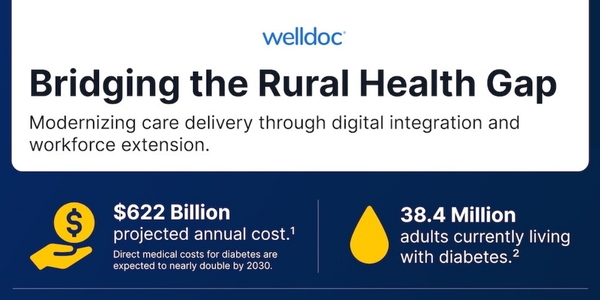
The Rural Health Gap: Why We Need More Than Just a “Transformation Fund”
Discover the future of chronic care management
.webp)
.avif)